


Standard insurance policies protect ordinary wealth. When your net worth reaches eight figures or beyond, those basic protections become inadequate.
At FirstMark Insurance Group, we’ve seen how ultra net worth coverage requires a fundamentally different approach. Your assets demand specialized strategies that standard policies simply cannot address.
What Ultra-High Net Worth Actually Requires
The Asset Complexity Problem
Ultra-high net worth families typically hold assets exceeding $30 million, but the threshold where standard insurance fails comes much earlier. Once your net worth reaches $10 million or beyond, traditional homeowners policies designed for middle-class protection become dangerously insufficient. The problem isn’t just about higher limits; it’s about asset complexity that standard underwriters don’t understand.
A $15 million estate with multiple properties, a private art collection worth $2 million, vintage cars, and international real estate creates exposures that a single homeowners policy cannot address. Standard policies impose sublimits on specific categories-art coverage often caps at $5,000 or $10,000, for example-leaving you massively underinsured. When a $500,000 painting suffers water damage, that $5,000 sublimit leaves a $495,000 gap.
Coverage Gaps in Vehicles and Liability
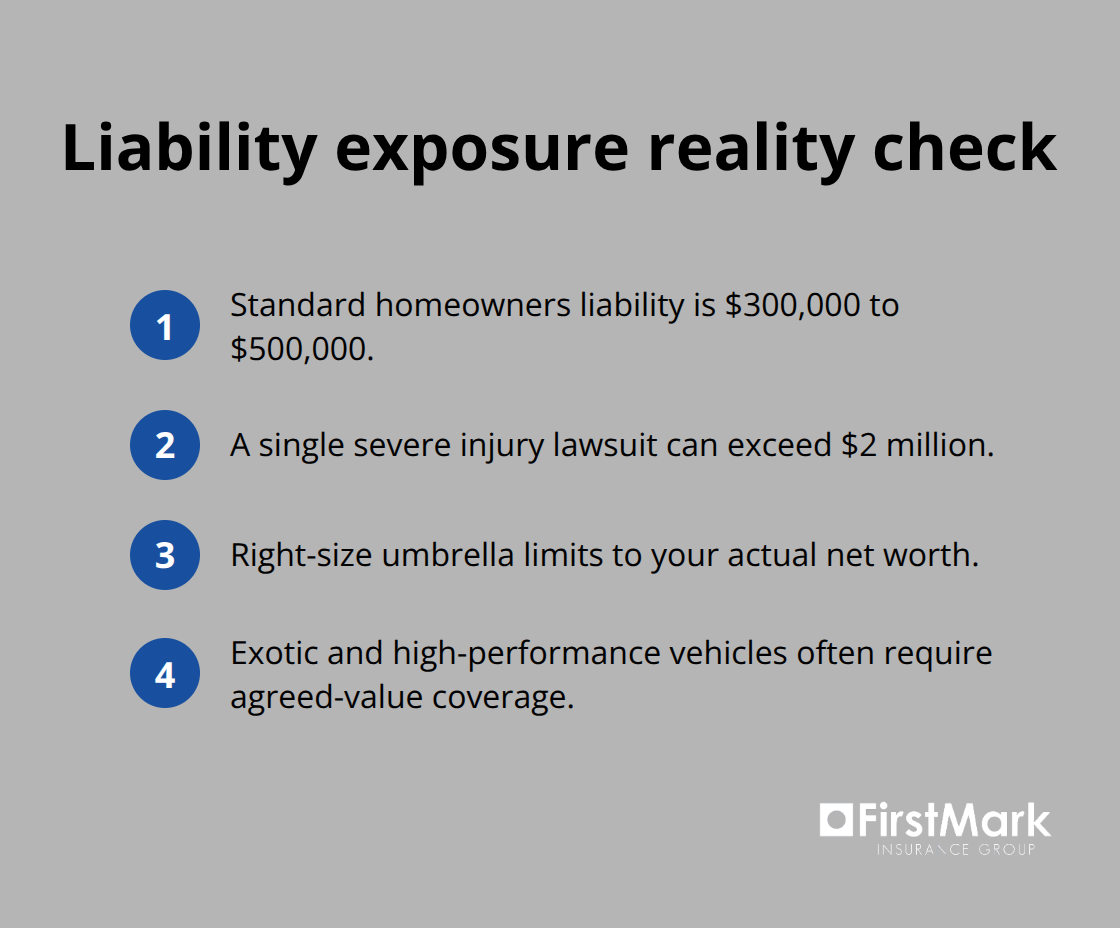
Standard auto policies exclude exotic vehicles and high-performance cars, offering no agreed-value protection for vehicles that appreciate rather than depreciate. The real exposure gap emerges in liability. A standard homeowners policy provides $300,000 to $500,000 in liability coverage, which sounds adequate until a guest suffers a serious injury at your property or your teenage child causes a significant accident.
One lawsuit from a severe injury can easily exceed $2 million in damages. Without proper umbrella coverage sized to your actual net worth, your personal assets become directly exposed to judgment. Most families discover these gaps only after a loss occurs, which is too late.
Specialized Asset Classes and Occupancy Risks
The complexity multiplies when you factor in lifestyle and occupancy patterns. If you own vacation properties, rental real estate, or maintain a private aircraft or yacht, each asset class requires specialized coverage that standard policies explicitly exclude or severely restrict. A rental property with a standard homeowners policy voids coverage entirely.
Domestic staff-household managers, nannies, chefs, security personnel-create employment practices liability exposure that typical homeowners policies don’t address. Event hosting, particularly with alcohol service, introduces liquor liability risks. International travel with valuable jewelry or collectibles requires worldwide coverage that standard policies don’t provide.
Tax, Estate Planning, and Insurance Alignment
Tax and estate planning complexities also demand insurance coordination that most standard policies ignore. If your wealth transfer strategy involves trusts, charitable giving, or business succession planning, your insurance structure must align with those arrangements, or you’ll face unintended tax consequences and coverage failures.
The shift from standard to specialized coverage isn’t optional for ultra-high net worth families-it’s a fundamental requirement to prevent catastrophic wealth erosion. Understanding these gaps is the first step. The next step involves identifying which specialized coverage solutions actually address your specific exposures and asset profile.
Specialized Coverage Solutions for Ultra-High Net Worth Families
Sizing Umbrella and Excess Liability Protection
Umbrella liability policies form the foundation of ultra-high net worth protection, but most families dramatically undersize them. A standard umbrella policy provides $1 million in excess liability coverage, which sounds substantial until you calculate actual exposure. If you own a $20 million estate with guest injuries, vehicle accidents, or property damage claims, a $1 million umbrella leaves $19 million in personal assets exposed to judgment. Umbrella coverage should reflect your total net worth, not arbitrary limits. For families exceeding $30 million in assets, umbrella limits should start at $5 million and often reach $10 million or higher.
The cost difference between a $1 million and $10 million umbrella is surprisingly modest-often $3,000 to $8,000 annually-making the additional protection economically sensible. Excess liability policies layer above umbrella coverage when exposures are severe or non-standard. A family hosting frequent events with alcohol service, maintaining a private aircraft, or operating rental properties should carry excess coverage specifically tailored to those activities rather than relying on blanket umbrella protection.
High-Value Home and Specialized Asset Coverage
High-value home insurance requires agreed-value appraisals rather than standard replacement-cost estimates. If your primary residence is worth $8 million but a standard homeowners policy provides $2 million in dwelling coverage, water damage or fire creates a $6 million gap. Agreed-value coverage eliminates depreciation calculations and guarantees full replacement at the appraised amount.

Art and collectibles demand separate specialized policies because standard homeowners policies impose sublimits of $5,000 to $10,000 regardless of actual value. A wine collection worth $500,000 or a jewelry portfolio worth $2 million requires standalone coverage with zero deductibles and worldwide protection. These specialized policies protect assets that appreciate over time and deserve coverage matching their true market value.
Executive and Fiduciary Liability Protection
Executive and fiduciary liability insurance protects you personally when serving on nonprofit boards, family foundation boards, or investment committees. A lawsuit alleging breach of fiduciary duty can cost $500,000 to $2 million in legal defense alone, and standard homeowners policies explicitly exclude this exposure. Directors and officers liability policies provide both defense costs and damages coverage, protecting personal assets when board service creates liability.
Families with significant charitable giving or complex trust structures face fiduciary exposure that most people never anticipate until a claim materializes. This coverage becomes particularly important as your wealth grows and your involvement in governance roles expands. The protection extends beyond your primary residence and vehicles to address the unique risks that accompany substantial assets and community leadership.
Understanding these specialized coverage layers reveals why standard policies fail for ultra-high net worth families. Each layer addresses specific exposures that blanket homeowners or auto policies simply cannot cover. The next step involves evaluating your current asset profile and identifying which coverage gaps pose the greatest risk to your wealth preservation strategy.
How to Structure Asset Protection Through Insurance
Align Your Insurance Architecture With Your Asset Structure
Protecting ultra-high net worth requires moving beyond higher coverage limits and instead building a coordinated advisory approach that separates risk exposure across multiple policies and entities. Your insurance architecture should mirror your asset structure. If you hold real estate through separate LLCs, maintain investment accounts in trusts, and operate business interests in distinct entities, your insurance must align with those legal separations rather than treating all assets as one monolithic exposure. When a lawsuit targets your primary residence, properly structured coverage prevents liability from cascading into your investment portfolio or business holdings. This separation principle extends to your vehicles as well. A luxury vehicle worth $800,000 should never sit under the same policy as a secondary vehicle worth $150,000, because underwriters apply different valuation standards and coverage terms to each asset class. Many ultra-high net worth families discover too late that their umbrella policy fails to cover losses on properties held in specific entities because the underlying policies weren’t properly coordinated with trust arrangements or LLC ownership structures.
Schedule Regular Coverage Reviews Tied to Life Changes
The second critical element involves scheduling regular coverage reviews tied to material life changes. Your insurance structure from five years ago becomes obsolete when you acquire an additional property, inherit substantial assets, or experience significant appreciation in your existing portfolio. Industry practice suggests quarterly reviews at minimum when your net worth exceeds $30 million, because market volatility and property value fluctuations create coverage gaps rapidly. A $10 million home appreciates to $12 million in two years, but many families never adjust their dwelling coverage limits accordingly, leaving a $2 million gap. Document your asset valuations annually through professional appraisals for real estate, art, jewelry, and collectibles, then cross-reference those values against your actual coverage limits.
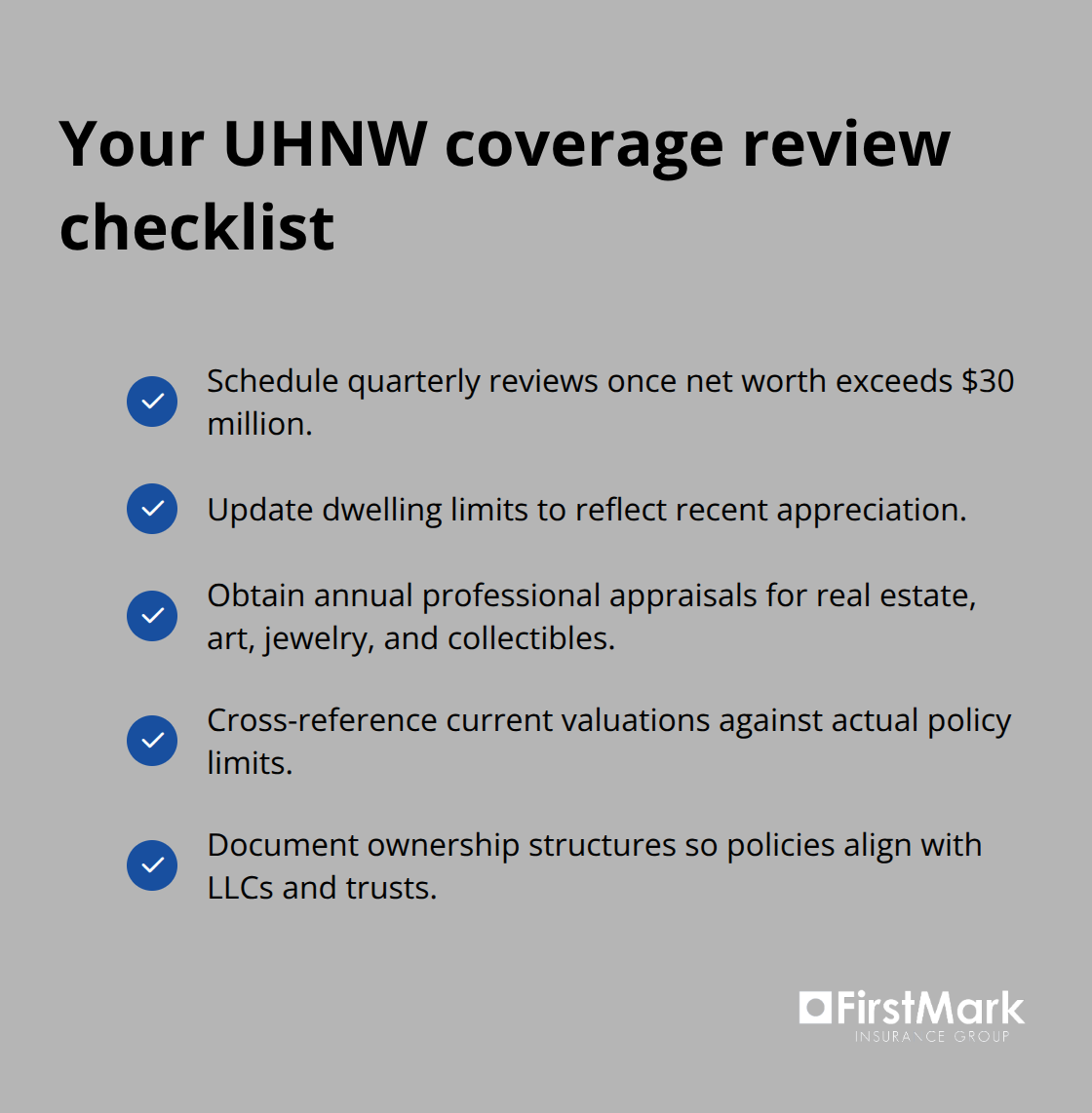
This simple discipline prevents the catastrophic discovery that your $3 million art collection carries only $50,000 in coverage when a loss occurs.
Assemble an Integrated Advisory Team
Finally, assembling the right advisory team matters more than selecting any single policy. Your CPA, estate attorney, and insurance advisor must communicate regularly about your overall wealth structure. Your attorney might recommend trust arrangements that create specific insurance requirements your CPA wasn’t aware of, or your insurance advisor might identify tax inefficiencies in your current structure that your other advisors can address. Most ultra-high net worth families maintain separate relationships with these professionals who rarely speak to each other, creating dangerous gaps in coordination. Quarterly coordination meetings (even brief ones) allow all parties to see the complete picture and identify conflicts before they become expensive problems. The advisory team approach costs more upfront through additional professional time, but it prevents the far more expensive scenario of discovering mid-claim that your coverage doesn’t apply because your legal structure wasn’t properly reflected in your insurance arrangements. FirstMark Insurance Group has spent 30 years helping families navigate these complexities by working alongside your other advisors to ensure your coverage aligns with your complete financial picture.
Final Thoughts
Standard insurance cannot protect what you’ve built. Ultra net worth coverage demands a fundamentally different approach that treats your assets as interconnected pieces requiring coordinated protection rather than isolated exposures needing separate policies. The families we work with at FirstMark Insurance Group understand this reality and recognize that protecting substantial wealth requires alignment between your legal structure, your tax strategy, your estate plan, and your insurance architecture.
Building comprehensive protection means treating insurance as part of your broader wealth preservation strategy, not as a standalone product purchase. This approach starts with honest assessment of what you own, where you hold it, and what exposures it creates, then continues through regular reviews that adjust your coverage as your assets appreciate and your family circumstances change. It requires coordination among your advisors-your attorney, your CPA, and your insurance professional-so each understands how the others’ recommendations affect your overall protection.
The cost of this coordinated approach remains modest compared to the cost of discovering mid-claim that your coverage fails to apply. Contact FirstMark Insurance Group to schedule a comprehensive review of your current coverage and identify the gaps that could expose your wealth to unnecessary risk.
Disclaimer: The information provided in this blog is for general informational purposes only and does not constitute legal, financial, or insurance advice. Coverage options, terms, and availability may vary. Please consult with a licensed professional for advice specific to your situation