


Your standard homeowners and auto policies likely leave significant gaps in protection. At FirstMark Insurance Group, we work with high net worth individuals throughout Seattle who discover these gaps only after facing a major liability claim.
Umbrella insurance fills those gaps with additional liability coverage that kicks in when your primary policies reach their limits. For someone with substantial assets, this layer of protection isn’t optional-it’s essential.
What Umbrella Insurance Actually Covers
How Umbrella Policies Work
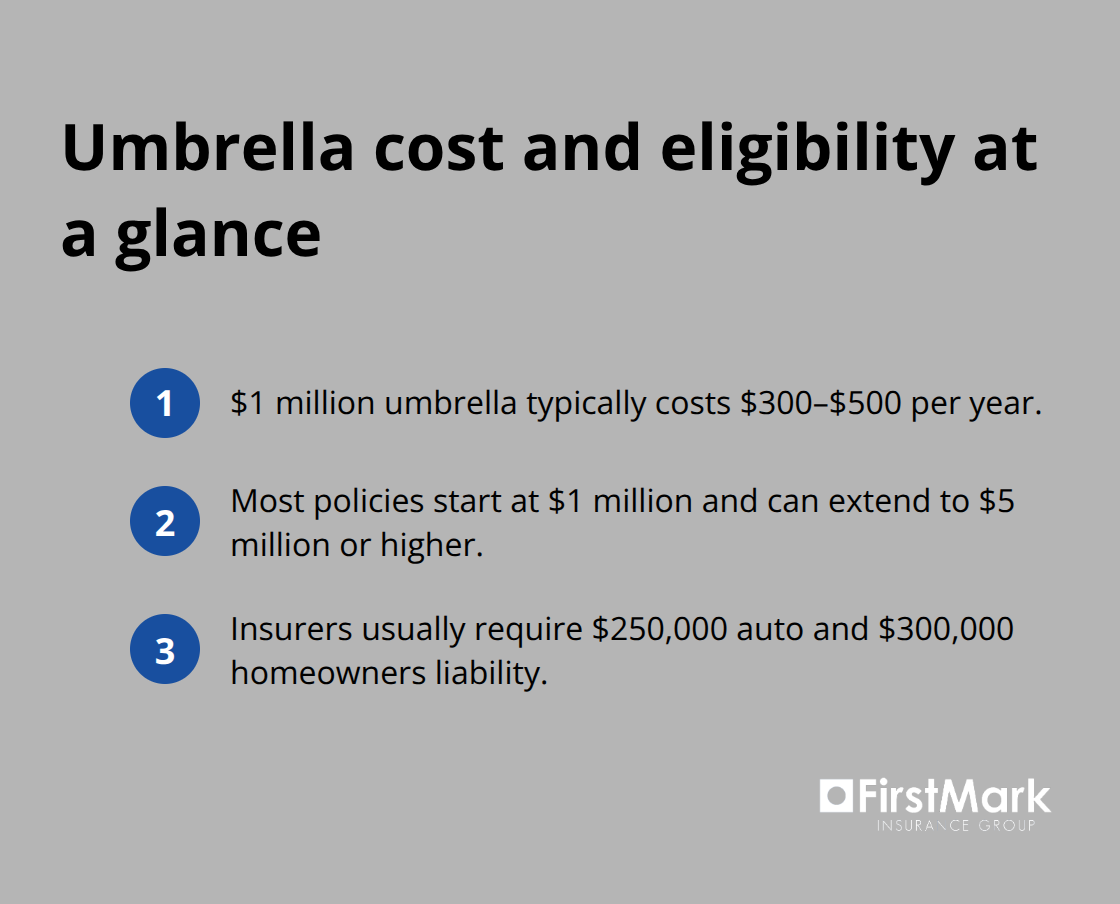
Umbrella insurance is straightforward: it’s excess liability coverage that activates after your home, auto, or watercraft policy limits are exhausted. If a serious accident occurs and damages exceed what your primary policies cover, your umbrella policy picks up the tab up to its limit. Most umbrella policies start at $1 million in coverage and extend to $5 million or higher. The Washington Office of the Insurance Commissioner notes that premiums for $1 million in coverage typically run $300–$500 annually, making it remarkably affordable relative to the protection it provides. Your umbrella doesn’t replace your underlying policies-it complements them. You must maintain adequate base coverage on your auto and homeowners policies, typically at least $250,000 in auto liability and $300,000 in homeowners liability, before an insurer will issue an umbrella policy.
What Your Umbrella Actually Protects
The coverage applies to bodily injury claims, property damage liability, and certain personal liability scenarios like defamation or false arrest. This protection extends worldwide, so incidents abroad are covered as well. If a family member posts defamatory content online or a guest suffers an injury on your property that results in a lawsuit, your umbrella policy can cover settlements and legal fees up to the policy limit.
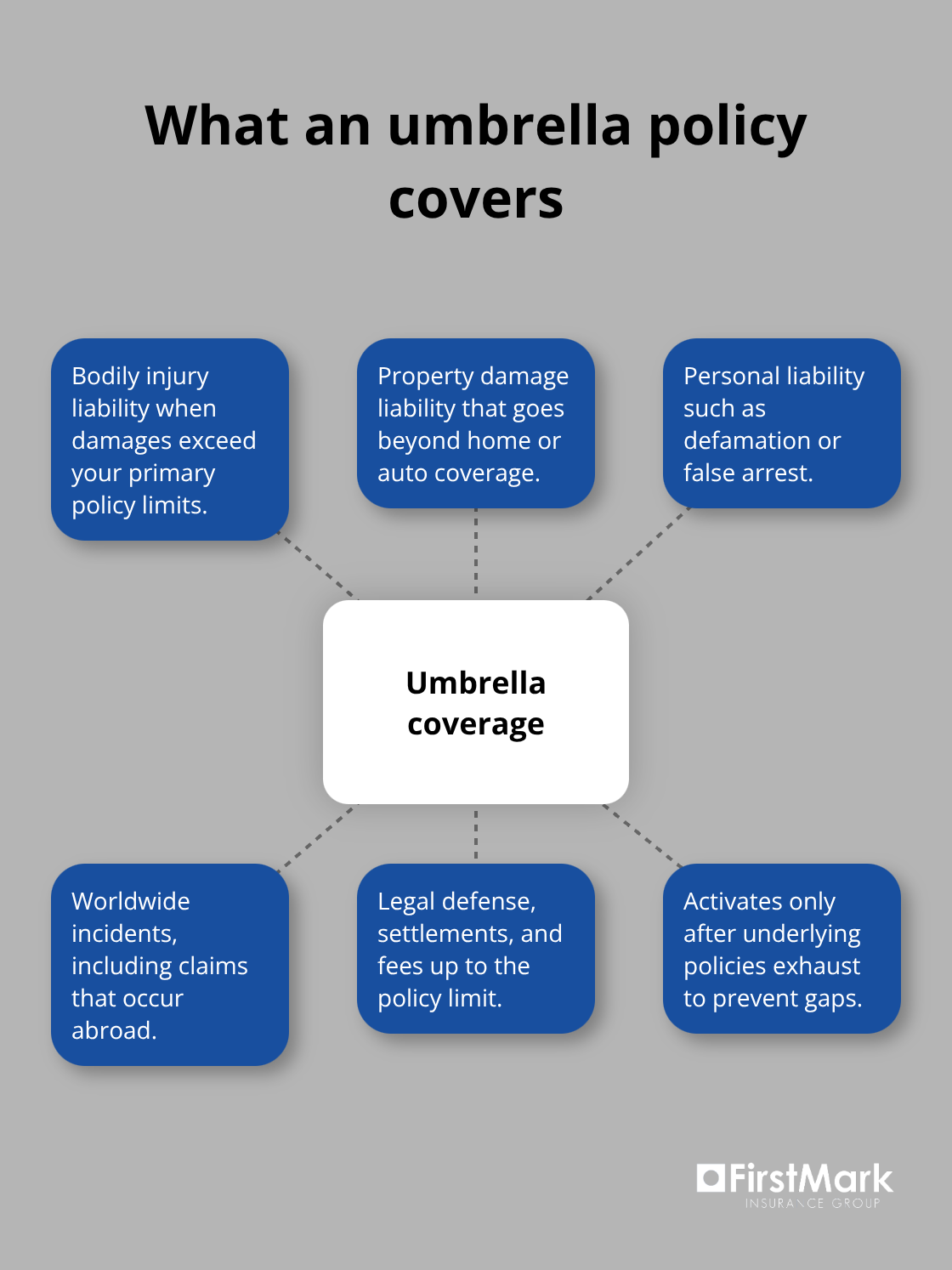
The policy activates only after your underlying coverage exhausts, which means coordination between your base policies and umbrella is essential to avoid gaps in protection.
Why Standard Policies Leave You Exposed
Standard homeowners policies max out at $100,000–$300,000 in liability protection, which creates dangerous exposure for Seattle residents. Seattle’s median home values exceed $800,000, meaning a single serious liability judgment can wipe out decades of home equity with a standard policy alone. Your auto insurance presents a similar problem. Washington state’s minimum auto liability requirements are just $25,000 per person and $50,000 per accident according to the Washington State Department of Licensing, yet catastrophic injury claims routinely exceed these thresholds. A high earner faces even greater risk because a judgment can attach to future income and wages, not just current assets.
The Real Cost of Being Underinsured
Without umbrella coverage, a single accident-a guest injured on your property, a serious car accident you cause, or a liability claim from a rental property-can force you to liquidate investments, drain retirement accounts, or face wage garnishment. One significant claim can destroy what you’ve spent years building. The legal defense costs alone (which can run from $10,000 to $50,000 or more depending on the case) add pressure to settle quickly, often at unfavorable terms. This is where understanding your actual exposure becomes critical for the next step in your protection strategy.
Coverage Gaps Your Current Policies Leave Exposed
Standard Homeowners Liability Falls Short of Your Wealth
Your homeowners policy contains a hard limit that doesn’t scale with your actual assets. Standard homeowners liability maxes out at $100,000 to $300,000, which sounds substantial until you calculate your real exposure. If your Seattle home is worth $800,000 and you have $200,000 in savings and investments, a single liability judgment of $500,000 wipes out half your liquid assets before umbrella coverage activates. Your home equity and investments sit unprotected once standard coverage exhausts. Even if you’ve purchased higher limits on your homeowners policy-say $300,000-a guest’s severe injury on your property can still generate damages that exceed that threshold. The gap between what your policy covers and what a serious accident costs is where your wealth becomes vulnerable.
Auto Insurance Leaves You Exposed to Catastrophic Claims
Your auto policy presents the same problem. Washington state’s minimum requirements are $25,000 per person and $50,000 per accident according to the Washington State Department of Licensing, yet a catastrophic injury claim involving permanent disability routinely exceeds $1 million. A multi-vehicle highway accident generates damages that surpass even higher limits you may have purchased (such as $250,000). High earners face additional exposure because creditors pursue future wages and income streams, not just current assets. A judgment against you extends to your paycheck for years, threatening the earning potential you’ve built over decades.
Uninsured and Underinsured Motorist Scenarios Create Hidden Gaps
The uninsured and underinsured motorist scenarios compound this exposure significantly. If an at-fault driver with minimal coverage hits you and causes $400,000 in damages, your uninsured motorist coverage (typically $50,000 to $100,000 on standard policies) covers only a fraction of your losses. You absorb the difference unless umbrella protection fills the gap. Legal defense costs alone reach $10,000 to $50,000 or more depending on case complexity, forcing you to settle claims quickly at unfavorable terms just to control expenses.
Rental Properties and Landlord Liability Exposure
Rental properties create their own gaps in protection. If you own a rental and a tenant or visitor suffers an injury, your landlord liability coverage may prove insufficient, especially if the claim involves permanent injury or multiple parties. Standard policies were designed for average homeowners with average assets, not for individuals with substantial net worth whose liability exposure extends far beyond the coverage limits these policies provide. This mismatch between your wealth and your protection is precisely why determining the right umbrella amount matters for your specific situation.
How Much Umbrella Coverage Do You Actually Need
Start With Your Total Asset Inventory
The right umbrella amount isn’t a one-size-fits-all number, and guessing leaves you either over-insured or dangerously exposed. Start with a clear inventory of your actual assets: home equity, investment accounts, savings, business interests, and future earning potential. If your Seattle home is worth $800,000 and you have $200,000 in investments and savings, you’re protecting roughly $1 million in exposed assets. That calculation alone suggests $1 million in umbrella coverage as a baseline, but Seattle residents typically face higher exposure than national averages.
Match Coverage to Your Unprotected Wealth
Dense neighborhoods, heavy traffic patterns, and the prevalence of waterfront properties create additional liability scenarios. A practical approach is matching your umbrella coverage to your total unprotected assets. If you own $1.5 million in property and investments, purchase $2 million in umbrella limits. If your assets total $3 million, consider $3 to $5 million in coverage. This approach accounts for the reality that a single serious claim can target both current assets and future income. High earners especially need to factor decades of earning potential into the calculation, not just today’s net worth. A judgment doesn’t stop at your bank account-creditors pursue wages and income streams for years afterward.
Understand How Premiums Scale With Coverage
A typical $1 million umbrella policy in Washington costs around $383 per year, meaning the cost per million increases only modestly as you add coverage. This efficiency makes higher limits increasingly attractive the more assets you have to protect. Your underlying policy limits directly constrain what an insurer will sell you in umbrella coverage. Most carriers require at least $250,000 in auto liability and $300,000 in homeowners liability before issuing an umbrella policy. If your current limits fall below these thresholds, you’ll need to increase them first, which actually strengthens your overall protection structure.
Account for Seattle-Specific Risk Factors
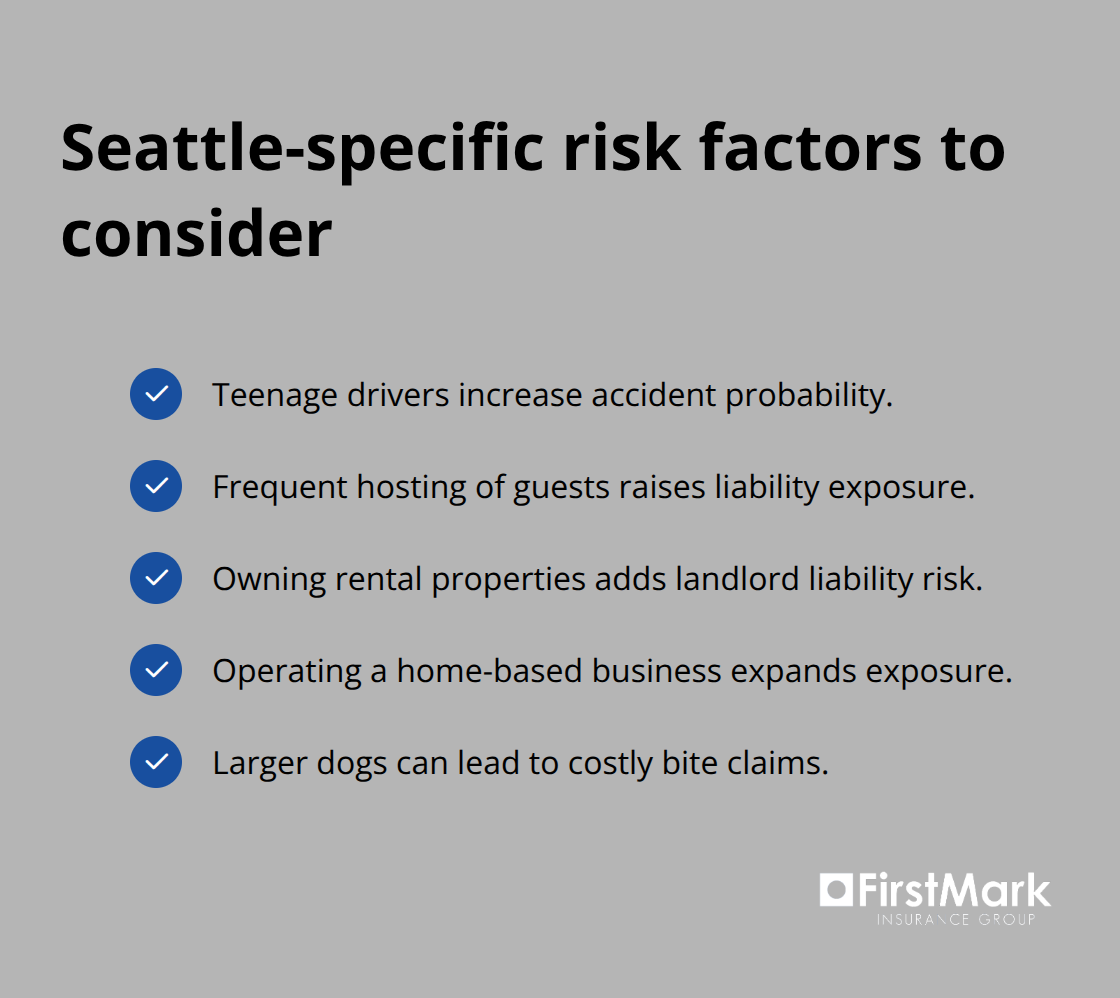
Seattle-specific factors warrant careful consideration: teenage drivers in your household significantly increase accident probability and should push your umbrella decision toward the higher end of your calculated range. Frequent hosting of guests, ownership of rental properties, or operation of a home-based business all create liability exposure beyond what standard policies contemplate. Pet ownership with larger dogs introduces another variable-a serious dog bite claim can exceed standard homeowners liability limits and fall directly to umbrella coverage.
Schedule a Professional Policy Review
The most pragmatic approach is scheduling a 15-minute policy review with an insurance professional who understands Seattle’s specific risk environment. This conversation surfaces gaps you may not recognize and helps you match coverage to your actual exposure rather than relying on generic recommendations. The greater financial risk lies in being underinsured rather than slightly over-insured, particularly when premiums scale so affordably with higher limits.
Final Thoughts
A single liability claim can unravel decades of financial progress, and without umbrella coverage, your home equity, investments, and future earnings remain exposed to judgments that standard policies won’t cover. The gap between what your homeowners and auto policies protect and what a serious accident actually costs is where your wealth becomes vulnerable. Seattle residents with substantial assets face this exposure daily, yet many operate with protection designed for average homeowners, not high net worth individuals.
Catastrophic claims routinely exceed standard policy limits by hundreds of thousands of dollars, and legal defense costs alone can force unfavorable settlements that drain your resources faster than the actual judgment. Premiums for meaningful coverage remain remarkably affordable relative to the protection they provide-a $1 million umbrella typically costs $300–$500 annually, making the financial argument straightforward. A high net worth umbrella Seattle policy protects what you’ve built without straining your budget.
Schedule a conversation with an insurance professional who understands your specific situation and can match your umbrella limits to your actual assets, income, and Seattle-specific risk factors. Connect with FirstMark Insurance Group to evaluate your protection strategy and build the financial security your wealth deserves. A 15-minute policy review surfaces gaps you may not recognize and clarifies exactly how much protection makes sense for your circumstances.
Disclaimer: The information provided in this blog is for general informational purposes only and does not constitute legal, financial, or insurance advice. Coverage options, terms, and availability may vary. Please consult with a licensed professional for advice specific to your situation