


Seattle’s wealthiest individuals face insurance challenges that standard policies simply cannot address. Your assets, lifestyle, and risk profile demand coverage tailored specifically to your circumstances.
At FirstMark Insurance Group, we work with ultra net worth Seattle clients who refuse to compromise on protection. This guide explores how specialized insurance strategies safeguard what you’ve built.
What Truly Defines Ultra-High Net Worth in Seattle
Ultra-high net worth in Seattle typically starts at $10 million in liquid assets, though many in this category exceed $30 million or significantly more. The threshold matters less than the reality: your wealth sits outside conventional insurance frameworks. Standard homeowners policies cap coverage around $1,500 to $2,000 on the average policy. A single piece of art, a waterfront estate, or a tech equity stake can exceed that limit within hours of market movement.
Seattle’s Wealth Concentration Differs Sharply from Other Regions
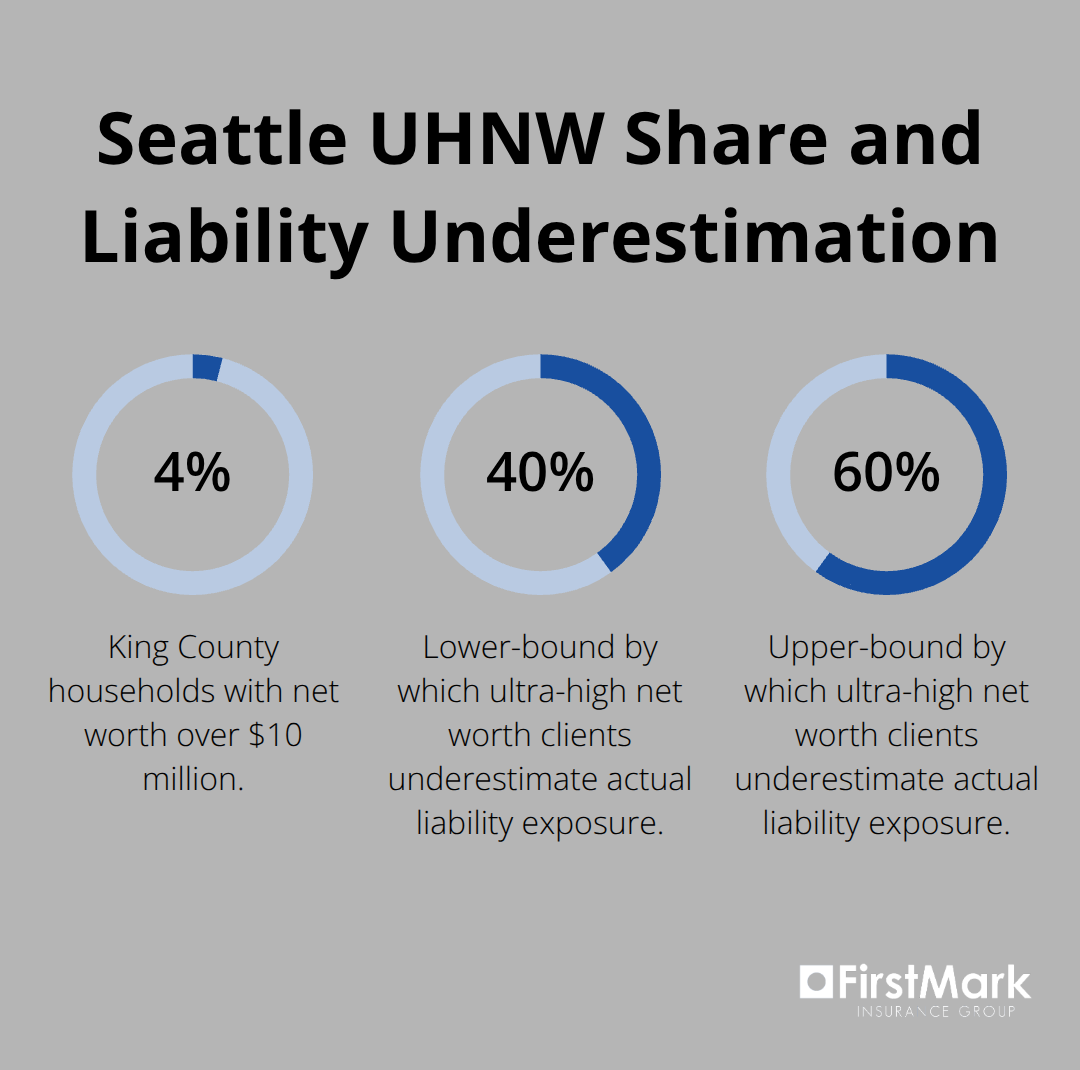
King County has approximately 41,000 households with net worth exceeding $10 million, representing roughly 4% of all households in the metro area, according to the U.S. Census Bureau. This density creates a distinct market where insurance providers either specialize in serving this segment or default to offering inadequate coverage. Your neighbors likely face similar complexity, yet each household’s specific risk profile remains unique.
Technology and Real Estate Drive Seattle’s Wealth Creation
Seattle’s economic foundation rests on technology, aerospace, and healthcare sectors that generate substantial capital gains and equity compensation. Amazon, Microsoft, and Boeing have created thousands of executives and former employees with significant liquid or restricted stock holdings. These assets behave differently than traditional income. A software engineer receiving $2 million in annual restricted stock units faces entirely different insurance exposures than a business owner with stable cash flow.
Real estate in Seattle’s desirable neighborhoods-Medina, Laurelhurst, Madison Park, and Queen Anne-regularly appreciates to $5 million to $15 million valuations. Waterfront properties command premiums that push single homes beyond $20 million. A tech executive managing restricted stock faces liquidity constraints and tax implications that standard umbrella policies never contemplate. An established business owner with real estate holdings across multiple counties encounters entirely different exposure patterns.
Your Coverage Gaps Likely Exceed Your Expectations
Most ultra-high net worth individuals discover their coverage inadequacy only after a loss occurs. A $5 million umbrella policy sounds substantial until you calculate that your primary residence, investment properties, art collection, and liability exposures could easily exceed $50 million in total value. Umbrella policies sit above home and auto coverage, meaning gaps in underlying policies create cascading problems. If your homeowners policy contains restrictive language around business activities or high-value collections, the umbrella layer becomes nearly worthless.
Executive liability represents another category entirely. If you serve on corporate boards, hold advisory positions, or maintain fiduciary responsibilities, standard personal liability coverage excludes these exposures. Directors and officers liability policies address this gap, but only when properly structured to account for your specific board memberships and compensation arrangements. Most ultra-high net worth clients underestimate their actual liability exposure by 40% to 60%. This gap exists because standard insurance conversations never address the full scope of your activities, assets, and risk profile.
These gaps in protection point toward a fundamental truth: your insurance strategy must move beyond standard policies and address the specialized coverage categories that actually protect concentrated wealth.
What Standard Policies Miss for Ultra-High Net Worth Portfolios
The Umbrella Policy Illusion
Your $5 million home in Medina sits alongside a $2 million art collection, $8 million in restricted stock, and board positions at three regional companies. A standard homeowners policy covers the structure to $1.5 million and personal property to perhaps $500,000. Your umbrella policy sits on top, but here’s the critical flaw: umbrella policies only protect against liabilities that fall within the scope of your underlying home and auto policies. If your homeowners policy explicitly excludes business activities or contains restrictive language around high-value collections, your umbrella layer becomes largely useless. This structural gap means a lawsuit related to your board service or a claim involving your art collection could exceed your actual protection by millions of dollars.
Fine Art Requires Specialized Protection
Fine art demands specialized coverage that accounts for appreciation, restoration costs, and replacement value at current market rates rather than original purchase price. A painting acquired for $300,000 in 1995 may now appraise at $1.2 million, yet standard homeowners coverage would reimburse only the original cost. Specialty insurers focus exclusively on high-value collections and understand the nuances that generalist carriers miss. These policies should specifically address agreed value coverage, meaning you and the insurer agree upfront on the item’s worth rather than arguing about value after a loss occurs.
Directors and Officers Liability Operates Separately
Executive liability operates in an entirely separate realm from personal coverage. If you serve as a director or officer on corporate boards, your personal liability exposure extends far beyond your personal activities. A shareholder lawsuit against a board you sit on could name you personally, regardless of whether you acted with proper care. Directors and officers liability policies specifically cover defense costs, settlements, and judgments arising from your board service. These policies typically range from $2 million to $10 million in coverage, depending on the company size and your compensation.
A technology executive receiving significant stock options faces additional exposures around securities liability if your company makes public statements about financial projections or market position. Many ultra-high net worth individuals hold multiple board positions simultaneously, yet their D&O coverage applies only to one company. Layering D&O policies across your board memberships requires careful coordination to avoid coverage gaps and ensure each policy knows about the others.
Fiduciary Liability Protects Your Trustee Roles
Beyond boards, fiduciary liability coverage protects against claims that you breached duties in managing investments, whether for a family trust, charitable foundation, or business succession plan. These specialized policies cost between $3,000 and $15,000 annually but address exposures that could cost millions to defend alone. Your fiduciary responsibilities (whether formal or informal) create distinct legal obligations that standard personal liability policies completely ignore.
Ultra-high net worth protection requires moving beyond single-policy thinking and building a coordinated strategy across multiple specialized coverages that address your specific activities and asset categories. This coordination becomes the foundation for understanding which additional protections your particular situation demands.
Your Insurance Partnership Requires Annual Scrutiny
Circumstances Shift Faster Than Coverage Adjusts
Ultra-high net worth situations change rapidly. A tech executive receives a significant equity grant, pushing restricted stock holdings from $8 million to $15 million. A board position ends, eliminating one set of fiduciary exposures while another begins. Real estate appreciates substantially, or you acquire a vacation property in a different state with distinct liability environments. Your art collection grows through acquisitions. Meanwhile, insurance markets tighten, coverage terms change, and new risk categories emerge that your current policies never contemplated. This reality makes annual policy reviews non-negotiable, not optional maintenance.
Meaningful Reviews Examine Your Entire Risk Landscape
A substantive review addresses specific changes in your asset base, business activities, board memberships, and liability exposures since the previous conversation. Each year should reveal what shifted in your coverage needs and why. If your insurance provider cannot articulate these changes, that provider is not conducting meaningful analysis. Your situation warrants an advisor who contacts you proactively when market conditions shift or new coverage options emerge that address gaps in your current structure.
Most ultra-high net worth clients work with advisors who wait for annual renewal dates rather than monitoring circumstances throughout the year. This passive approach leaves substantial protection gaps unaddressed for months or years until a loss occurs. The difference between reactive and proactive advisory work determines whether your coverage actually protects what you’ve built.
Direct Access to Decision-Makers Matters
You need direct access to advisors who understand your complete financial picture, not phone trees or representatives reading from scripts. An insurance advisor serving ultra-high net worth clients should know your occupation, your board positions, your real estate holdings across multiple states, your art collection details, and your family structure without asking you to repeat information annually. This knowledge enables proactive recommendations when circumstances change.
If you serve on a new board, your advisor should immediately contact you about D&O coverage gaps. If you acquire waterfront property, your advisor should discuss specialty coverage for that specific location and property type. If tax law changes affecting restricted stock treatment, your advisor should explain implications for your coverage strategy.
Proactive Monitoring Throughout the Year
Your insurance strategy should evolve as your circumstances change, not remain static from renewal to renewal. An advisor who maintains detailed client profiles can respond immediately when your situation shifts. This approach costs more in advisory time and attention than mass-market carriers invest, but the difference in protection quality justifies the investment entirely.
Your wealth deserves an insurance partner who treats your account with the scrutiny you’d expect from your wealth manager or tax advisor. FirstMark Insurance Group, with 30 years of experience guiding families and businesses through insurance complexities, cherishes client connections and provides valuable information throughout the year to keep your coverage aligned with your evolving needs. This commitment to regular communication and proactive guidance separates advisors who truly understand ultra-high net worth protection from those who simply process renewals.
Final Thoughts
Ultra net worth Seattle clients operate in a fundamentally different insurance environment than standard policyholders. Your assets, activities, and liability exposures demand coverage strategies that acknowledge this reality rather than forcing your circumstances into generic frameworks. Standard policies fail because they were designed for average situations, not concentrated wealth across multiple asset categories and professional responsibilities.
Working with an experienced insurance agency transforms this complexity into clarity. An advisor who understands ultra-high net worth protection recognizes that your $5 million home represents only one component of your total risk picture, that board positions create distinct liability exposures, and that restricted stock holdings demand specialized consideration. This expertise matters because insurance gaps often remain invisible until a loss occurs, at which point the protection you thought you had disappears.
The difference between adequate and inadequate coverage frequently comes down to whether your insurance partner monitors your circumstances throughout the year or simply processes renewals. At FirstMark Insurance Group, we bring 30 years of experience guiding families and businesses through insurance complexities, and we make it a point to regularly provide valuable information throughout the year, ensuring your coverage aligns with your evolving needs.
Disclaimer: The information provided in this blog is for general informational purposes only and does not constitute legal, financial, or insurance advice. Coverage options, terms, and availability may vary. Please consult with a licensed professional for advice specific to your situation