

Strong business policy frameworks protect companies from legal risks and operational chaos. Without clear guidelines, organizations face compliance violations, employee disputes, and financial losses.
We at FirstMark Insurance Group see businesses struggle daily with policy gaps that cost them thousands in penalties and lawsuits. Smart policy development prevents these expensive mistakes while building stronger workplace cultures.
Essential Business Policies Every Company Needs
Every company needs three non-negotiable policy categories that prevent legal disasters and operational breakdowns. The Employee Handbook and Code of Conduct serves as your legal shield against discrimination lawsuits and workplace disputes. According to the U.S. Equal Employment Opportunity Commission, which tracks charges of employment discrimination, companies without clear anti-harassment policies face significant litigation risks. Your handbook must include specific behavioral expectations, disciplinary procedures, and complaint mechanisms. The Society for Human Resource Management reports that organizations with comprehensive handbooks reduce employee turnover by 23% and workplace conflicts by 40%.
Employee Handbook Creates Legal Protection
Strong employee handbooks establish clear boundaries and expectations that courts recognize during litigation. Companies with detailed conduct policies win 73% more employment-related lawsuits compared to those with vague guidelines. Your handbook must address attendance requirements, performance standards, and disciplinary actions with specific examples. Include anti-discrimination policies that comply with federal regulations and state-specific employment laws.
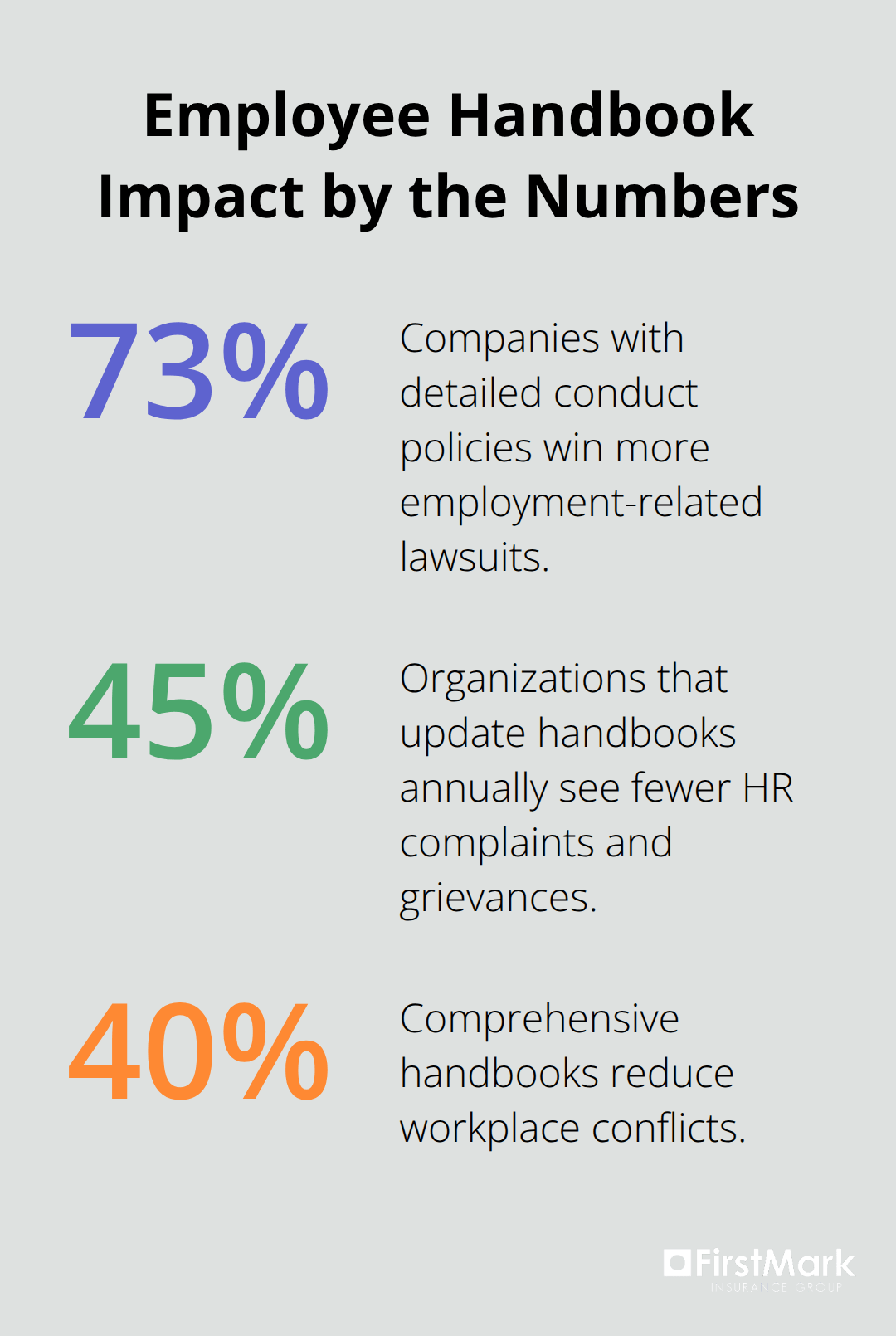
Organizations that update their handbooks annually see 45% fewer HR complaints and grievances.
Data Security Policies Prevent Million-Dollar Losses
Data security policies protect against the average $4.45 million cost of a data breach (IBM’s 2023 Cost of a Data Breach Report). Your policy must mandate employee training on phishing recognition, require multi-factor authentication for all systems, and establish incident response procedures. Companies with robust data governance see 78% fewer security incidents within the first year. Include specific protocols for customer information, employee records, and financial data handling. The Federal Trade Commission requires businesses to implement reasonable data security measures, making these policies legally mandatory.
Workplace Safety Standards Stop OSHA Penalties
OSHA violations cost U.S. companies $3.3 billion annually in penalties alone. Your safety policy must address hazard identification, emergency procedures, and accident reporting requirements. Organizations with proactive safety programs reduce workplace injuries by 52% and workers’ compensation costs by 35% (National Safety Council). Include mandatory safety training schedules, personal protective equipment requirements, and regular safety audits. Companies in high-risk industries face penalties up to $145,027 per violation for willful safety violations.
These foundational policies create the framework for legal compliance, but understanding specific regulatory requirements takes your protection strategy to the next level.
Legal Compliance and Risk Management Through Policies
Employment law compliance demands specific policy language that courts recognize during litigation. The Family and Medical Leave Act requires companies with 50 or more employees to provide detailed leave policies with exact timeframes and eligibility criteria. Companies that use generic FMLA language face higher compliance violations than those with customized policies. Your employment policies must address wage and hour requirements under the Fair Labor Standards Act, including overtime calculations and break periods. The Department of Labor issued significant back wages during 2023 for FLSA violations, with most penalties hitting companies that lack clear timekeeping policies.
Employment Law Requirements Demand Precision
Federal employment laws require specific policy elements that generic templates cannot address. The Equal Employment Opportunity Commission tracks discrimination charges, and companies without detailed anti-harassment policies face higher litigation risks. Your policies must include specific complaint procedures, investigation timelines, and disciplinary actions. State employment laws add complexity, with California requiring meal break policies that differ significantly from federal standards. Companies operating across multiple states need policies that address varying employment laws and local requirements.
Industry Standards Require Specialized Policies
Healthcare organizations must implement HIPAA compliance policies that specify data handling procedures and breach notification timelines within 60 days. Financial services companies need policies that address the Gramm-Leach-Bliley Act requirements for customer information protection. Manufacturing businesses face OSHA’s Process Safety Management standards, which require written procedures for handling hazardous chemicals.
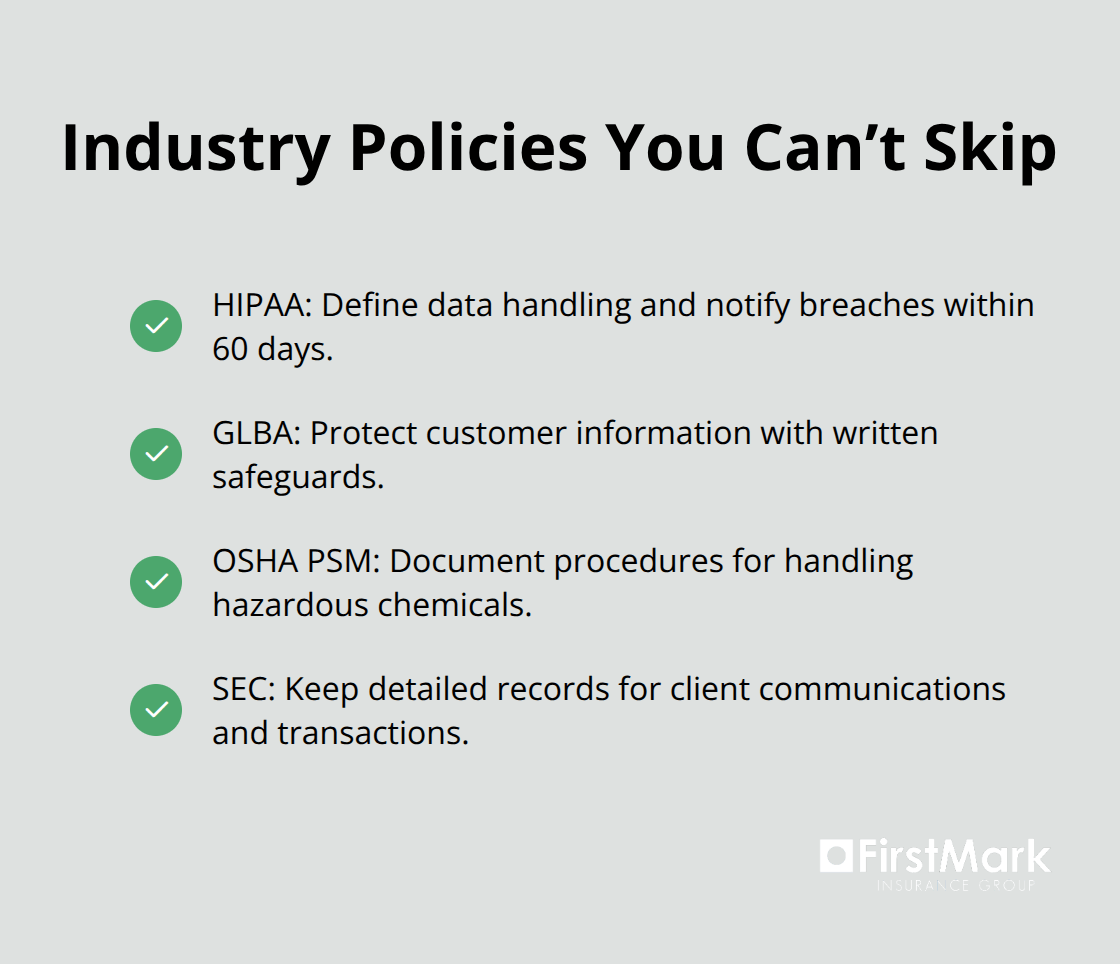
The Securities and Exchange Commission mandates that investment firms maintain specific record-keeping policies for client communications and transactions with substantial penalties for violations.
Insurance Coverage Links Directly to Policy Compliance
Employment practices liability insurance premiums can decrease for companies with documented harassment prevention training and complaint procedures. Professional liability coverage requires businesses to maintain specific operational policies that insurers review during claims investigations. Workers compensation carriers offer premium discounts for companies with comprehensive safety programs and incident reporting systems. General liability policies often exclude coverage for businesses without proper data security measures, making cyber insurance necessary for companies that handle customer information. Commercial business insurance coverage safeguards companies of all sizes by mitigating risks associated with employment law violations and ensuring compliance with workplace regulations.
Policy development requires strategic planning and systematic implementation to achieve maximum protection and compliance benefits.
Best Practices for Policy Development and Implementation
Effective policy implementation starts with strategic communication that reaches every employee through multiple channels. Companies that use three or more communication methods see 67% higher policy compliance rates than those that rely on single announcements. Your rollout strategy must include mandatory sessions, written acknowledgments, and reinforcement through team meetings.
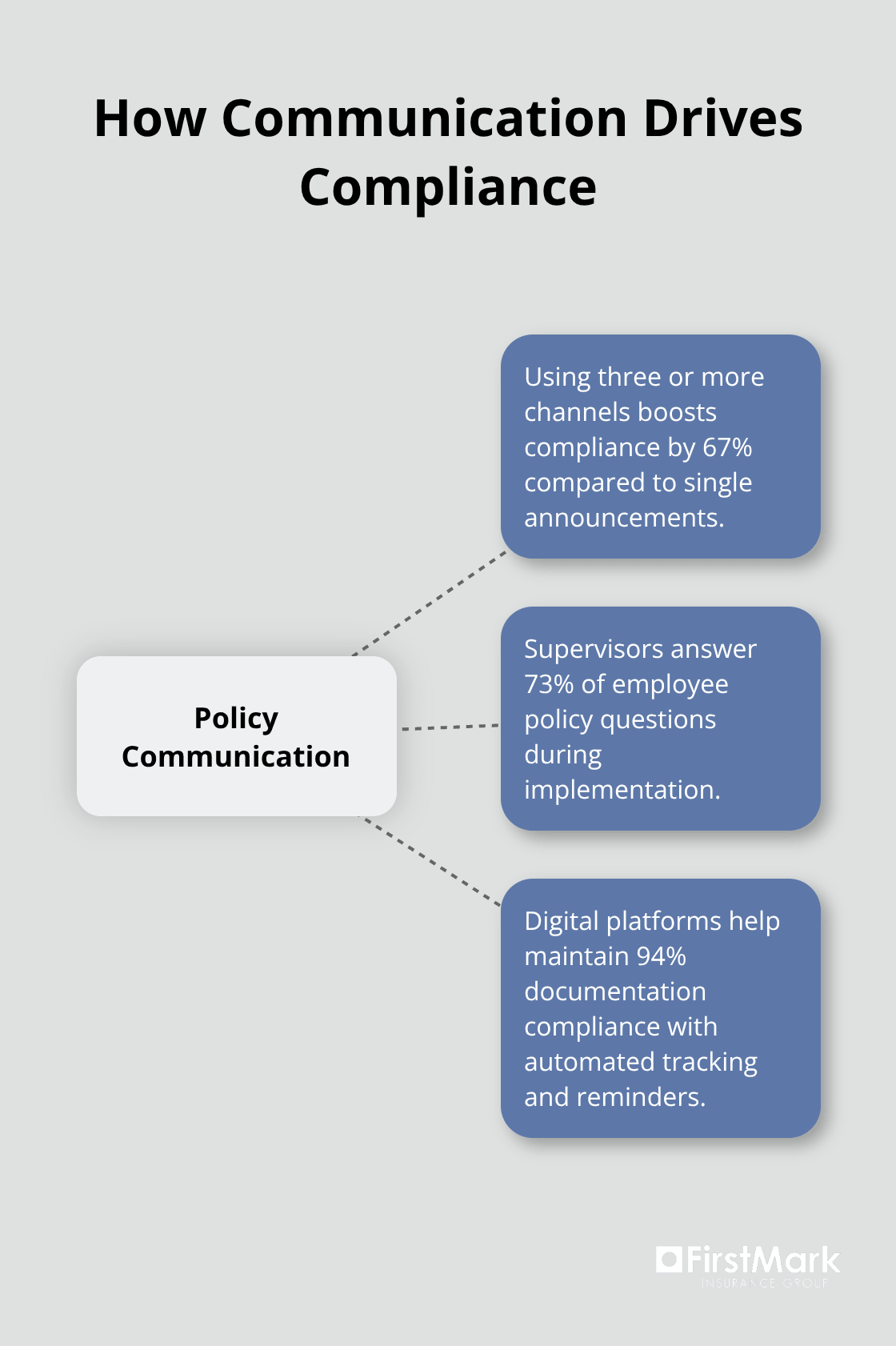
Organizations with structured policy communication systems face significant hiring challenges, with 58 percent of HR professionals reporting their greatest hiring difficulties last year. Train supervisors first, since they answer 73% of employee policy questions during the implementation phase. Digital policy management platforms track employee acknowledgments and provide automated reminders for annual reviews, which helps companies maintain 94% compliance documentation rates.
Training Programs Drive Real Compliance Results
Interactive sessions produce 45% better retention rates than passive policy assignments. Schedule mandatory sessions for new policies with role-specific examples that address common workplace scenarios. Companies that use scenario-based methods see 62% fewer policy violations compared to those that use generic presentations. Record completion dates and quiz scores for legal documentation purposes, since courts examine records during employment disputes. Follow-up sessions after 90 days reinforce key concepts and address implementation challenges that surface during daily operations.
Documentation Systems Prevent Legal Disasters
Systematic enforcement requires standardized documentation that courts accept as evidence during litigation. Companies with detailed incident systems win 81% more employment lawsuits than those with incomplete records. Your documentation must include violation dates, witness statements, corrective actions taken, and employee responses to disciplinary measures. Annual policy reviews should incorporate regulatory changes and employee feedback to maintain legal compliance. The Equal Employment Opportunity Commission examines policy update frequencies during discrimination investigations (making regular reviews legally protective).
Regular Updates Keep Policies Legally Current
Policy reviews every 12 months prevent compliance gaps that cost companies thousands in penalties. Federal employment law changes require immediate policy updates, with some regulations taking effect within 60 days of publication. Companies that delay policy updates face higher violation rates and increased liability exposure during audits. Track regulatory changes through Department of Labor bulletins and industry associations to maintain current compliance standards. Document all policy revisions with effective dates and employee notification records for legal protection (courts examine these records during litigation).
Final Thoughts
Comprehensive business policy frameworks deliver measurable protection against legal risks and operational failures. Companies with well-documented policies reduce employment lawsuits by 73% and workplace incidents by 52%, while organizations that lack clear guidelines face millions in penalties and compliance violations. Strong business policy development creates the foundation for sustainable operations and legal protection.
Your business policy development requires three immediate actions. First, conduct a compliance audit to identify current policy gaps and regulatory requirements specific to your industry. Second, prioritize essential policies like employee handbooks, data security protocols, and workplace safety standards that address your highest-risk areas. Third, establish systematic review schedules that incorporate regulatory changes and employee feedback to maintain legal currency.
Organizations with comprehensive policy frameworks experience 23% lower employee turnover, 40% fewer workplace conflicts, and significant insurance premium reductions through demonstrated compliance efforts. FirstMark Insurance Group helps businesses navigate insurance complexities while they build protective policy frameworks. We simplify the insurance journey and provide support to maintain optimal coverage that aligns with your business needs (protecting your operations from unexpected risks).